
STAFFORD – At a time when education often feels bigger, faster and more crowded, one local school is proving that small can be powerful. With only 50 students in total, Lighthouse Christian Academy (LCA) is combining faith-based learning with hands-on academics, giving its middle schoolers tools typically found in far larger districts.
At LCA, a pre-K through eighth-grade school that has served the community for more than 45 years, hands-on STEM learning is not an “extra.” It’s part of the heartbeat of the school’s mission to cultivate “critical thinkers and compassionate leaders” grounded in faith and academics.
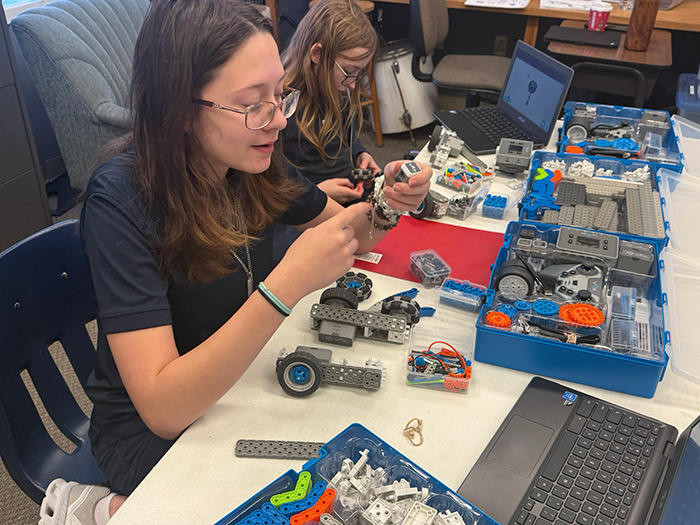
On one particular school visit, that mission had wheels. Four middle school students leaned over tables covered in metal pieces, tiny screws and bright plastic components.
It looked a little like a Lego convention. However, it was anything but child’s play.
Building Innovators, One Robot At A Time
Bill Clanton wears several hats at LCA. He serves as co-administrator and music teacher, working closely with Erin Scott on curriculum, events and enrollment, and also leads weekly chapel services. In addition, Clanton supports the school’s expanding STEM initiatives and serves as a key point of contact for families.
“These are VEX robots,” explained Clanton, gesturing toward the half-built machines taking shape in front of him. “We don’t actually own them. We were able to get them through the state lending library as part of our STEM grant program. It’s something we couldn’t otherwise afford, but the state makes it available.”
The robotics initiative is tied to LCA’s expanded STEM curriculum, which includes computer science, coding, and programming. Computer Science Teacher Nicole Mackow coordinates the robotics resources through the Central New Jersey Education Hub. Although her schedule conflicted with the interview, Clanton was quick to credit her.
“Miss Mackow is the reason we have access to this,” he said. “She teaches in Lakewood during the day and comes here three afternoons a week. Because of her, our students aren’t just learning about technology; they’re actually building and coding it.”
In this middle school class, there are only four full time students and one other part time. And they wouldn’t have it any other way.
“We’re All Really Close”
The small class size isn’t an accident. At LCA, the largest class caps at 15 students. Once enrollment reaches that number, another teacher is hired.
“That’s the joy of a school this size,” Clanton said. “If a student is struggling, I can pull them aside immediately. We can work through it. They’re not just a number.”
For seventh grader Annie, that closeness is what sets the school apart. “We’re all really close,” she said. “It’s like we’re siblings in a way. In public schools you switch classes all the time, so you don’t really get close to teachers. Here, you actually can.”
The students speak easily with their teacher. They laugh together. They tease one another. It feels less like a classroom and more like a team workshop.
Building With Your Brain
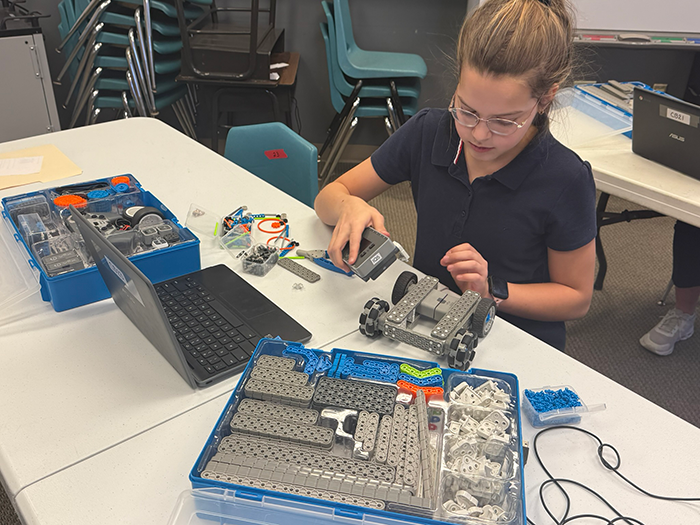
Thirteen-year-old Melodee carefully fitted connectors together, explaining the process as she worked.
“It’s kind of like Legos,” she said. “These pieces are like connectors. You can follow directions, but you can also make your own.”
This is their second round using the VEX robots. The first time, they built the basic robot structure. This time, they’re adding features – including a claw attachment.
“Today I’m adding a claw so it can pick things up,” Melodee said. “With the controller, you press a button and the claw closes.”
Eighth grader Catarina lit up when asked about the technology side. “I always love doing different things like technology,” she said. “I like different kinds of sciences. I prefer Earth science, but really any science.”
Does she see this as part of her future? “I might want to study science,” she said thoughtfully. “But I want to be an innovator.”
That word – innovator – lingers in the room. It’s not something you hear every day from a 14-year-old. But here, it doesn’t sound unusual at all.
Coding Comes To Life
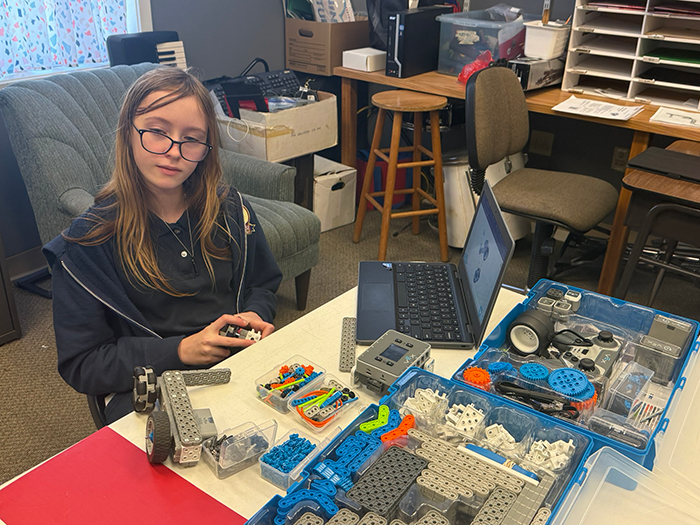
Across the table, the innovation continued, this time through code. Cadence demonstrated the coding platform. With a few taps and dragged commands on the screen, she programmed the robot to move and play a sound.
“What I’m doing right now is putting in the different components,” she explained. “So, when I move the controller like this, it goes forward. When I turn it, it turns.”
Within seconds, the robot beeped to life. “That sound just means it connected,” she said matter-of-factly.
The students haven’t yet worked extensively with sensors, but they understand the concept. “If something gets close,” one student explained, “You can code it so it backs up.”
It’s problem-solving in real time. Trial and error. Adjustment and retry. Exactly the kind of hands- approach aligned with the school’s expanded STEM programming.
The post Ocean County Students Build Their Futures With Robotics Program appeared first on Jersey Shore Online.