

TOMS RIVER – Mayor Daniel Rodrick has vetoed an ordinance designed to stop him from commuting to his separate job as an assistant principal in Irvington using a township-issued vehicle, escalating a dispute that has been simmering for months at Township Council meetings over vehicle use, compensation and taxpayer-funded benefits.
The ordinance amended township code Section 23-10 to state that “traveling to and from work shall not be considered official business” and restricted township vehicles from leaving municipal boundaries except for official township purposes.
The Township Council approved the ordinance on a 4-3 vote, with Council President David Ciccozzi, Vice President Thomas Nivison and council members Robert Bianchini and Clinton Bradley voting in favor. Council members Craig Coleman, Harry Aber and Lynne O’Toole voted against the measure.
The vote fell along familiar lines, as the council majority are usually opposed to the mayor and the other three are usually supporting the mayor.
Under Toms River’s Faulkner Act form of government, overriding the mayor’s veto would require a five-vote supermajority. That means at least one council member who voted against the ordinance would need to switch positions for an override to succeed.
Attorney, Rodrick Criticize Ordinance Language
Rodrick defended the veto by arguing the ordinance was improperly drafted and would have consequences beyond his own use of a township vehicle. He sharply criticized the council majority, saying they “have no idea what they’re doing, and they never use the lawyer.”
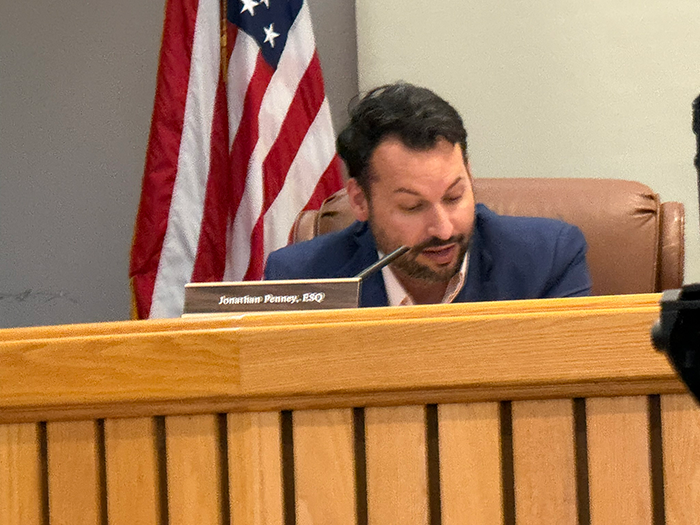
Township attorney Jonathan Penney confirmed he has not been consulted by the council majority members on any of their legislation before it is introduced. “It is unclear who is drafting their ordinances,” he said.
Penney added that in its present form, the ordinance would have prohibited police detectives from taking their vehicles out of town.
“To make it easier, it wouldn’t have affected myself, the police chief, or the business administrator,” Rodrick said.
A vehicle policy document adopted by the governing body by resolution in August 2025 appears to contain conflicting language regarding township vehicle use. Under the section defining “Official Use” and “Official Business,” the policy states that the mayor, business administrator and chief of police are authorized to utilize township vehicles for personal use.
However, another section of the same policy later outlines the limited circumstances under which township vehicles may be taken out of town. Under Section 10, the policy states that traveling to and from work is not considered official business.
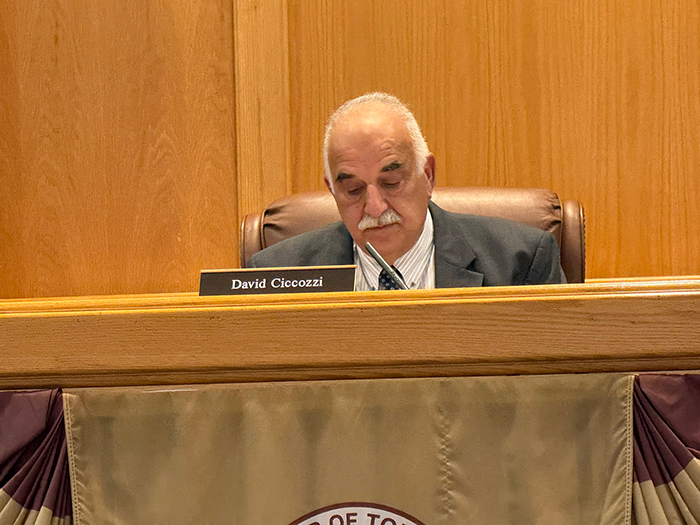
Ciccozzi: Ordinance Only Restricted Commuting
Council President Ciccozzi maintained the ordinance was intended to prevent the mayor from using a township vehicle to commute to his separate employment in Irvington rather than eliminate the mayor’s access to a township vehicle altogether.
“We didn’t vote to take the car away,” Ciccozzi emphasized in an interview after the meeting. “We voted to stop him from using it for his ‘first job’ in Irvington.”
Nobody is taking this car away,” Ciccozzi said. “The only thing that we’re saying is, can’t go up the Parkway with it and come back to Toms River with it. No personal use.”
Ciccozzi said the ordinance would still allow legitimate out-of-town travel for township business if properly documented. The council president also disputed Rodrick’s argument that the mayor should be considered a full-time official because he is effectively on call at all hours.
“You can’t run a township from your cell phone,” Ciccozzi said. “That’s what he does. He’s not in town hall; he just runs the town from his cell phone.”
Rodrick: Better Ways To Save Taxpayers Money
The mayor continues to argue that the ordinance has unfairly singled him out, while ignoring what he described as far more costly taxpayer-funded benefits provided to elected officials and Toms River Municipal Utilities Authority commissioners.
“I would gladly turn over the vehicle, even though every mayor before me had access to a vehicle, and it’s compensatory,” Rodrick said during the council meeting. “However, I would gladly give up the vehicle and have said that if we would do something about this outrageous policy where people get a health policy for 30 minutes a month.”
Rodrick contends that council members receive “a $40,000 health insurance policy and $10,000 a year,” while MUA commissioners “come to one half an hour meeting a month and get a $40,000 health insurance policy.”
An Open Public Records Act request seeking documentation supporting the compensation and benefit figures cited by the mayor has not yet been fulfilled. The township extended the request beyond the seven-business-day response deadline permitted under New Jersey law.
Rodrick also emphasized that he considers the vehicle part of his compensation package, and that he pays about $1,000 in taxes for it. “I am the lowest paid mayor of all the large cities,” Rodrick wrote. “I make less than a person who cuts the grass for the township. I do, however, get an automobile as part of my compensation.”
The mayor also defended his use of the township vehicle by comparing it to prior administrations. “(Former mayor) Tom Kelleher not only had a vehicle, but he had a full-time driver,” Rodrick said. “Most mayors of large municipalities have a car and a full police detail. I do not take a police officer everywhere that I go.”
Records confirming the staffing and security arrangements referenced by Rodrick were not immediately available, and this newspaper has not independently verified the mayor’s characterization of prior administrations.
Rodrick also maintained that the responsibilities of mayor extend well beyond traditional business hours. “My job is 24 hours a day seven days a week and the phone never stops,” Rodrick wrote in a text message. “As you can see, I’m even working at 7 o’clock in the morning on my vacation.”
Separate MUA Ordinance Was Pulled
The dispute over the mayor’s vehicle unfolded alongside a separate ordinance involving health benefits for Toms River Municipal Utilities Authority commissioners.
Council Vice President Thomas Nivison objected to the addition of a proposed ordinance that would have eliminated health benefits for MUA Commissioners. “This was just added to the agenda,” he said. “It wasn’t brought up at the agenda meeting.”
During the meeting, Bianchini also questioned whether the Township Council had the authority to directly eliminate benefits provided through the MUA’s separate budget structure. “We up here vote on the township budget,” Bianchini said. “This is for the MUA.”
Nivison moved to indefinitely table the ordinance before it could proceed further. The Toms River MUA operates under a separate budget with benefits listed as a separate line item. Requests for documentation regarding health benefits have been made and responses delayed beyond the statutory limits.
Penney separately weighed in on the broader benefits issue. “I think the law is very clear on full time benefits for part time elected officials and appointed part time board members after 2010,” Penney wrote. “It’s not permitted.”
With the veto now issued and the MUA benefits ordinance indefinitely tabled, the broader fight over compensation, benefits and taxpayer-funded perks appears far from over in Toms River.
The post Toms River Mayor Vetoes Ordinance Targeting Vehicle Commute appeared first on Jersey Shore Online.
