
JERSEY SHORE – There is a saying that time heals all wounds, but that really isn’t true. Time only fades the scars. You are left with the memories.
Like many along the Jersey Shore, I felt the sting of Superstorm Sandy 14 years ago. I was covering it as a journalist, but I was also living it as a longtime resident while caring for my two ailing parents. Both would die in the months that followed, leaving me and their Chihuahua, who was over 12 years old, living in their senior community after I had been displaced.
We knew the storm was coming. I covered a press conference somewhere in Monmouth County held by then-Governor Chris Christie, and the message was clear: This was something to take seriously. I recall shooting video the morning before the storm hit near the Coast Guard station up the street from me in Ortley Beach. I never realized that the footage would capture some of the last images of that structure before it was destroyed and later replaced.
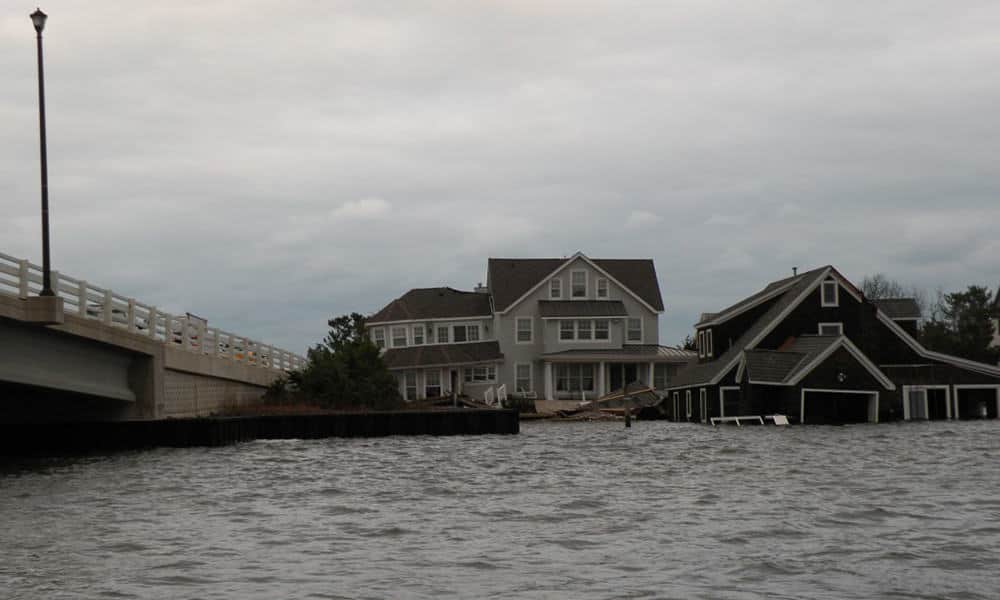
Ortley Beach and Mantoloking were considered ground zero for the devastation of Superstorm Sandy, and for good reason. While there was plenty of damage elsewhere, the landscape of the northern barrier island would be forever changed.
The storm destroyed homes and property, leaving us with images of boats in the middle of Route 37 in Toms River, a water-filled sinkhole with an SUV in Lavallette, and devastation at the Mantoloking bridge. Transportation was disrupted, and residents were displaced from the barrier island and beyond.
I vividly recall a phone conversation with then-Seaside Heights Mayor Bill Akers, who told me he had stayed in town during the storm. The borough’s roller coaster was now in the ocean, and most of the boardwalk was gone.

I waded through knee-high water while covering Toms River neighborhoods the day after the storm, near the evacuated home of friends. Later, I crossed the bridge to the barrier island to witness the horror of what remained.
I joined then-Toms River Police Chief Michael Mastronardy, now Ocean County sheriff, who was kind enough to stop by my home so I could see that at least the structure was intact. The damage inside had yet to be explored.
We toured the barrier island and saw what could only be described as a war zone. Mother Nature had torn through the area, uprooting entire homes and ripping roofs off others. The streets were filled with sand.
As we traveled north near Ocean Beach, we could smell gas and see a fire still being extinguished. Firefighters dressed in protective gear battled a blaze that had engulfed an entire oceanfront section of the community.
As a reporter, you are supposed to take all this in and record it, whether with a pad and pen, a recorder or a camera. You document everything you observe. You try to set your emotions aside, yet this area was my home. I had traveled Route 35 for decades for work and recreation, and what I saw was horrific.
Perhaps one of the most emotional scenes involved a truck carrying people who had chosen to stay through the storm despite the mandatory evacuation order. Among those in the back was an elderly couple. They looked cold, scared and tired. I asked how they were doing and why they had stayed despite the warnings.
They lived in Normandy Beach or Chadwick Beach, and the husband responded, “I know we shouldn’t have done it, but my wife has dementia and she didn’t want to leave. I stayed with her because she was too afraid to leave.”

I still remember the man’s face and his voice, as if he were apologizing for staying. I wish I hadn’t even asked the question. I paused, feeling tears in my eyes.
This elderly couple had survived a horrible experience together. Whatever happened during that storm, they were going to face it together.
The storm wasn’t one or even two nights. Not really. Its impact would be felt for years.
On a later visit to the barrier island with Mastronardy, I saw the barren property on Third Avenue in Ortley Beach where Saint Elisabeth Chapel once stood. It was the church where I was married in 2000.
The property had been wiped clean, as if the chapel had never been there. The same was true of a home across the street, whose owner had asked about a floor safe containing important documents.
It had snowed the night before, leaving the ground covered, but the chief went out to try to find the safe. What he located instead was a shiny silver menorah.
He fell on his way back to the police vehicle. A CNN reporter and I had been instructed to remain inside, but we wanted to help when we saw him fall.
“I’m alright, stay there,” he instructed us.
I was sitting in the front seat beside the chief when he contacted the homeowner. He said he would return to look for the safe after the snow cleared, but he had found the family’s menorah.

The woman was thankful. The chief and I looked at each other, and I swear there were tears in both our eyes. It was a sad occasion, but something meaningful had been recovered. It offered a little hope.
There are so many other stories I could share from that time. These are just some of my observations, and I know so many people have their own stories to tell.
The landscape of the barrier island, particularly Ortley Beach, is different now. We rebuilt homes and raised our residences. Some sold their properties. Many were able to build new homes.
We restarted our lives, but the memories remain.
So does the kindness of the people who came to help: those who distributed hot chocolate, cleared asbestos materials from beneath our homes, stripped houses to their studs in preparation for demolition, or simply helped us clean up.
Those who helped wipe away the mud and grief won’t be forgotten, either.
Like 9/11 and the pandemic, Sandy marks a chapter of our lives that we will always remember. It is part of us now, and we survived.
The post Fourteen Years After Sandy, The Scars And Kindness Remain appeared first on Jersey Shore Online.