

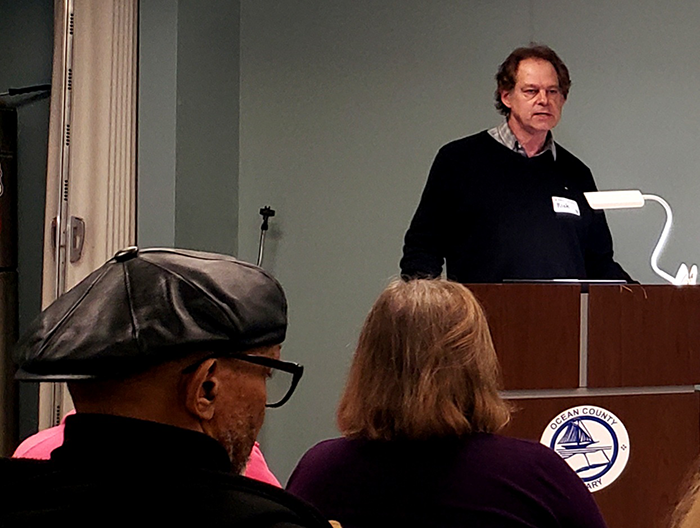
BRICK – The life, times and music of jazz musician Miles Davis was chronicled recently by presenter Rick Feingold during a recent program sponsored by the Friends of the Brick Library.
Feingold’s program at the Brick Library provided a slideshow tracing the troubled life of Davis whose music was methodical, easy going, emotional and thought-provoking in sharp contrast to own mood and personal challenges.
He reviewed Davis’s 1959 album “Kind of Blue” which is the most successful jazz recording of all time featuring John Coltrane and Julian “Cannonball” Adderley on saxophone, Davis on trumpet, Bill Evans on piano, bassist Paul Chambers, and drummer Jimmy Cobb.
For this album, new band pianist Wynton Kelly replaced Evans on “Freddie Freeloader.” The album was recorded at Columbia’s 30th Street Studio in New York City in two sessions on March 2 and April 22, 1959.
Feingold noted that “Kind of Blue” is regarded by critics as Davis’s masterpiece and was the greatest jazz album ever recorded, and one of the greatest albums of all time.
The album’s impact on music, including jazz, classical music and rock led song writers to also deem it one of the most influential albums ever made. It was one of 50 recordings chosen in 2002 by the Library of Congress for the inaugural year of the National Recording Registry, being deemed “culturally, historically, or aesthetically significant.”
Davis had a penchant for having almost no rehearsal and the musicians had little idea what they were to record on the album. As described in the original liner notes by Evans, Davis had only given the band sketches of scales and melody lines on which to improvise.
After the musicians assembled, Davis gave only brief instructions for each piece and then set to taping the sextet in the studio. Feingold noted that while the results were impressive with so little preparation, the persistent legend that the entire album was recorded in one pass is untrue.
Feingold noted that only “Flamenco Sketches” yielded a complete take on the first try. That take, which is not the master, was added to the 1997 CD reissue of the album as a bonus track. An insert for the ending to “Freddie Freeloader” was recorded, but was not used for release or on the issues of “Kind of Blue” prior to the 1997 reissue.
Ironically, late in his career he would no longer perform music from that album and most of his prior work saying, “so what, they were done in that era, the right hour, the right day and it happened and it’s over. We had the energy then and we liked it. I have no feel for it anymore.” In another interview Davis remarked, “jazz is dead just so you know, it’s over.”
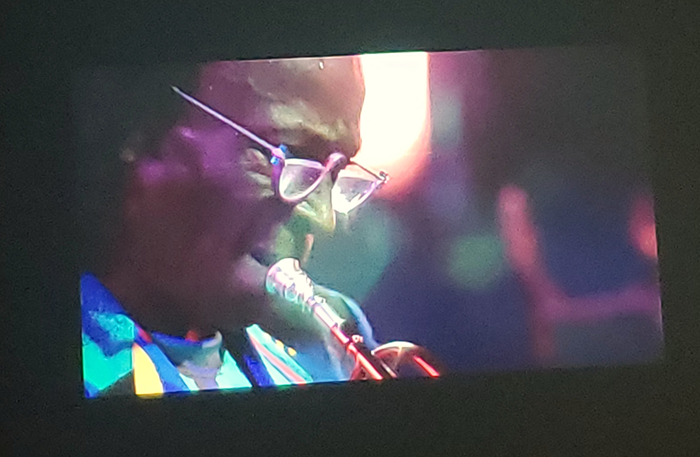
Feingold’s presentation featured footage of Davis’s performances along with some commentary from his contemporaries and colleagues who worked with him on his albums who knew about his life and his music. “These videos have great interviewers, great commentators – not just stuffy professors.”
Feingold said “in 1949 Davis performed at the Paris International Jazz Festival on his first trip abroad, Davis took a strong liking to Paris and its cultural environment.”
“He felt people of color were better respected than in the US. The trip he said, quote: ‘changed the way I look at things forever.’ That is where he met singer and actress Juliette Gréco.”
Feingold said Davis had a short, intense, and profound romance in Paris in 1949, where they bonded over music and art, free from the intense racial prejudice of America. “It was a very passionate romance. He didn’t marry her as he said ‘I love her too much to make her unhappy’.”
Davis remarked in an interview in one of the video clips that “this was my first time out of the country and I loved being in Paris and the way I was treated. The food even tasted better in France. The smell of the air was even more beautiful in Paris. I was so into music. I didn’t have time for any kind of romance until I met Juliette Gréco.”
“Juliette and I would walk down to the river together holding hands and kissing. We’d look into each other’s eyes and kiss some more. I had never felt like this before in my life,” Davis said in an interview.
Davis had several significant partners, most notably his wives Frances Taylor, Betty Mabry, and acclaimed actress Cicely Tyson, with whom he was married from 1981 to 1989.
Commentators noted that Gréco brought Davis into “a circle of intellectuals, artists and philosophers of that time. Jazz was seen at that time as the height of artistry within creative circles and he was treated as an equal by some of the most creative giants of the day. It showed him one can be fully one’s self beyond the boundaries of race.”
Davis eventually had to return to America and noted his dread of going back during his flight to New York City. His temper would prove a problem for him and others over the years that stemmed from a volatile mix of substance abuse, perfectionism, paranoia, physical pain, and frustrations with racism. This led to his reputation for having a bad temper and sometimes violent outbursts, though some also recognized his sensitivity beneath the surface.
Feingold noted that Davis’s famous raspy voice resulted from an accident in 1955 after throat surgery to remove vocal cord polyps; doctors told him to stay silent, but he got into a shouting match just days later, permanently damaging his vocal cords and giving him a signature, hoarse whisper.
He explained that a single emotional outburst after Davis’s procedure, made his voice a poetic reflection of his controlled, yet passionate, artistry that became part of his persona.
Davis died in 1991 from complications including a stroke, pneumonia, and respiratory failure, stemming from a long battle with poor health, including diabetes, sickle cell anemia, and substance abuse. While pneumonia was a primary factor, his health was weakened by those conditions, leading to a fatal decline after a hemorrhage during a hospital stay.
He was buried with one of his special custom-made trumpets, specifically the black-colored “Moon and Stars” trumpet designed for him by Larry Ramirez, as a significant tribute to his legendary career.
The post Presentation Recalls Life Of Jazz Musician Miles Davis appeared first on Jersey Shore Online.