
TOMS RIVER – Mention roller derby to someone of a certain generation and chances are they’ll smile. They remember the nicknames. The speed. The spills. The skaters flying around the track on Saturday morning television while parents drank coffee and kids watched wide-eyed from the living room floor.
Others discovered the sport decades later through the film “Whip It.” Either way, roller derby has a way of staying with people. What many people may not realize is that it never really disappeared. It simply evolved.
At Winding River Skating Center in Toms River, there are still colorful nicknames, hard hits and plenty of excitement. What you’ll also find is something the old television broadcasts rarely showed: a community built on friendship, confidence and the belief that it’s never too late to try something new.
Names like Bettie Rage, Chesty McBruiser, Mighty Mouse, Care Bear Carnage and Jack N Choke carry on one of roller derby’s most enduring traditions. For Jeanine Longobardi, who skates as J9 Jolter, that tradition is deeply personal. Her derby name honors her grandfather, Joe, who competed decades ago with the Jersey Jolters, serving as a reminder that while the sport has evolved, its spirit remains remarkably unchanged.
Founded in 2007 by four women, Jersey Shore Roller Derby draws members from Ocean, Monmouth, Middlesex and Atlantic counties. The league belongs to the Women’s Flat Track Derby Association (WFTDA), the governing body for modern flat-track roller derby.
The people who make up the league are as diverse as their derby names. Teachers, counselors, nurses, professors, and business owners, are among those who come together several times each week to practice, compete and support one another. The league currently includes about 25 active members and continues rebuilding after membership declined during the pandemic.
More Than A Sport
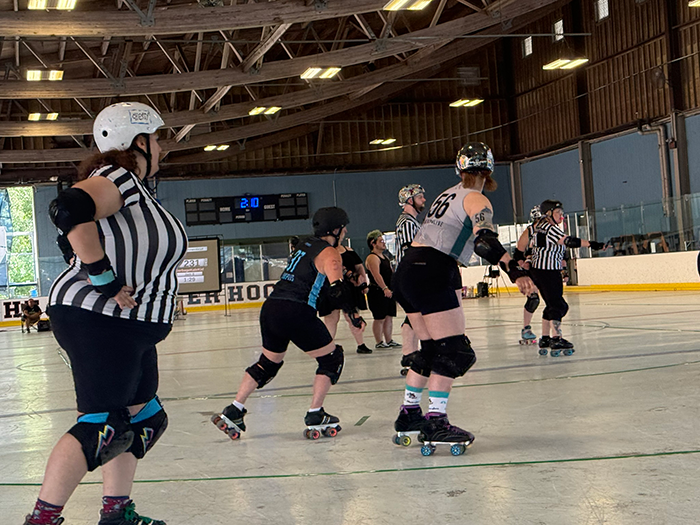
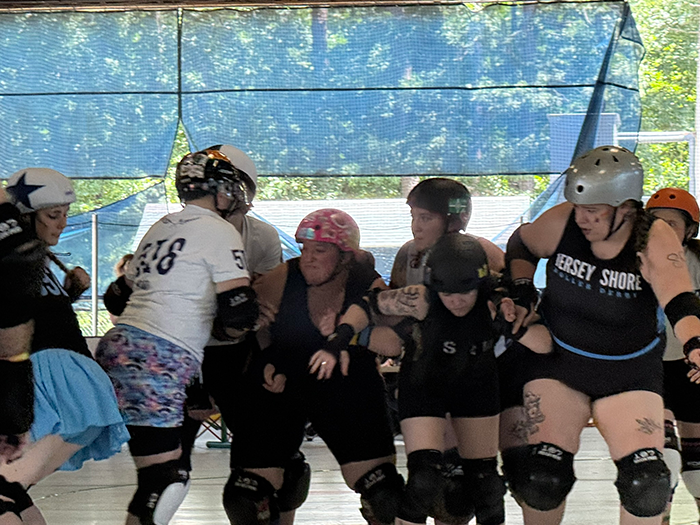
At a recent bout against the Connecticut Cutthroats, the sound alone told part of the story. Wheels rattled across the polished floor as skaters circled the track. Referees skated backward while tracking the action, whistles ready at a moment’s notice. Blockers formed human walls designed to stop the opposing jammer from slipping through.
Then, in an instant, everything changed. A Jersey Shore jammer spotted a narrow opening, lowered a shoulder and darted through a gap that seemed too small to exist. Another skater absorbed a hard hit, bounced off the floor and was back on her feet before many spectators realized she had fallen. A Connecticut skater seemed to glide through the track with the grace of a dancer, using occasional leaps to keep up with the relentless pace.
For first-time spectators, the action can seem chaotic. Five skaters from each team compete at a time, with four blockers working to help their jammer break through the pack and score points. Yet beneath the collisions and speed lies a sport built on teamwork, communication and trust.
Kerri Patton, known on the track as Bettie Rage, said the biggest challenge often comes long before a skater enters a bout. “I think it’s finding the confidence initially,” said Patton, who serves as the league’s treasurer, coach and one of its primary organizers. “A lot of times people are joining something as a full-grown adult and automatically thinking, ‘I’m not going to be able to do this.’”
Patton joined the league in 2013 while searching for a fresh start and found confidence and community on the track. She said her teammates share a common bond. “We always say it seems like if you have to be super nice and take care of people in your real life, you gravitate toward roller derby so you can just let it all loose.”
Many newcomers haven’t worn skates since childhood, and some have never participated in a contact sport. That’s why the first lesson isn’t how to score points. It’s how to fall.
Patton said learning to get back up after a fall often becomes a lesson that extends beyond roller derby itself. “It’s also about being more assertive,” she added. “You can’t be timid when you’re out on the track.”
Longtime league member Catherine Galesky, known as Chesty McBruiser, now referees and coaches after injuries limited her skating career. “Jersey Shore Roller Derby is a way to build community for yourself while participating in a fun, exciting group sport,” she said. “Our league is currently one where you can go at your own pace to develop skills relating to the sport, or to participate as an official on or off-skates.”
For Galesky, one of the most rewarding parts of roller derby is watching newcomers discover strengths they never knew they possessed. “As a longtime skater and official, what’s most exciting to me is helping and welcoming others to join our community and see their confidence grow as they learn how to skate, block, jam and strategize, while having a fun time,” she said.
The community extends well beyond the rink through social gatherings, fundraising efforts and volunteer activities. The league regularly partners with charitable causes and nonprofit organizations. Its most recent bout against the Connecticut Cutthroats served as a fundraiser for the Make-A-Wish Foundation after one skater’s nephew benefited from the organization’s support while facing a serious medical challenge.
(Photo by Stephanie Faughnan)
Not every game ends in victory. Yet league members measure success by far more than what appears on the scoreboard. As the organization continues rebuilding, every bout represents another opportunity to gain experience, sharpen skills and welcome new members into the fold.
The league is actively recruiting skaters, referees and non-skating officials. Adults 18 and older can attend monthly new skater nights. No previous roller derby experience is required. More information is available through Jersey Shore Roller Derby’s website and social media pages.
Some of the league’s favorite memories have little to do with winning. Patton recalls a tournament years ago when Jersey Shore won an earlier game but found itself exhausted and badly outmatched in its next matchup. Knowing tacos awaited them after the final whistle, the team began chanting “Tacos! Tacos! Tacos!” from the bench as the score became increasingly lopsided.
Years later, they still laugh about it.
For all the hits, bruises and sore muscles, that story may capture roller derby’s appeal better than any final score. The sport is competitive. The athletes take it seriously. But at its core, Jersey Shore Roller Derby is about something bigger than winning.
It’s about finding confidence when you need it most. Building friendships that last beyond the rink. Learning that falling isn’t failure. Sometimes, it’s simply part of learning how to get back up again.
The post Jersey Shore Roller Derby Rolls On appeared first on Jersey Shore Online.